The order is expected to be quickly challenged in court, where the Trump administration’s previous efforts have been struck down as unconstitutional.
Listen to this article
0:00
Learn more. This feature uses an automated voice, which may result in occasional errors in pronunciation, tone, or sentiment.

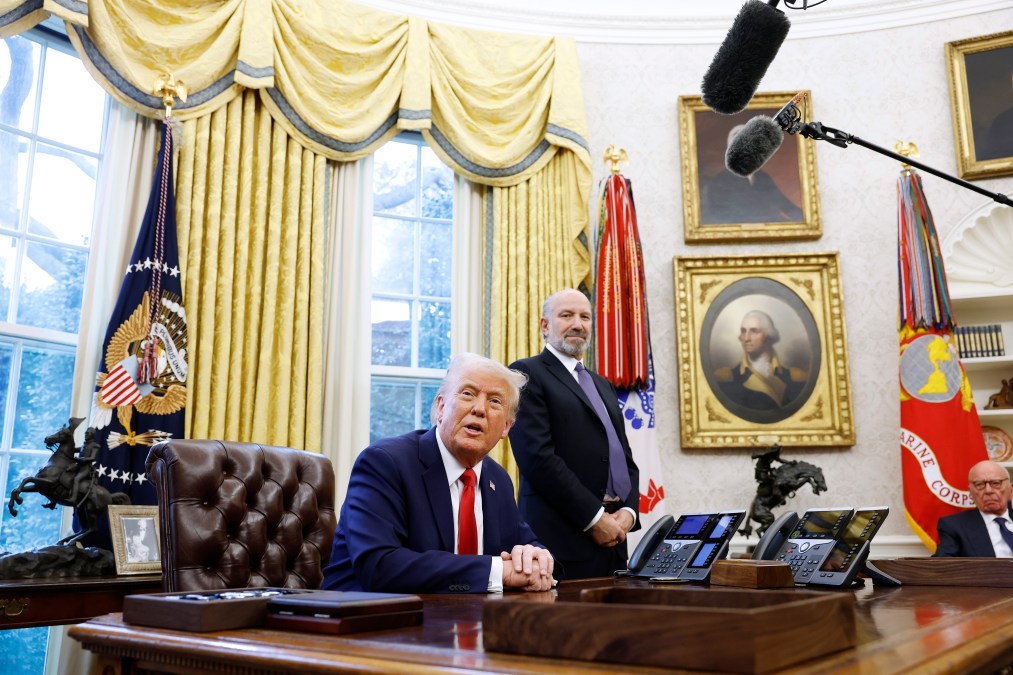
President Donald Trump signed an executive order Tuesday that purports to limit mail-in voting, though critics say the move will almost certainly be challenged in court on constitutional grounds.
The order instructs the Homeland Security secretary, the director of U.S. Citizenship and Immigrations Services and the commissioner of the Social Security Administration to compile lists of American voters for each state, including their supposed citizenship status.
To build the lists, the agencies would rely on the controversial Systemic Alien Verification for Entitlements database that DHS has been building under the Trump administration, as well as Social Security and federal citizenship and naturalization records.
Those lists would then be transmitted to states, most of which have already rejected previous Trump administration efforts to collect voter data or dictate voter registration lists. The White House order instructs the Department of Justice to prioritize the investigation and prosecution of state and local officials or any others involved in the administration of federal elections who issue federal ballots to individuals not eligible to vote in a federal election.
The order also directs the postmaster general to issue new proposed regulations that require mail-in ballots to be mailed in special envelopes that include barcodes for tracking. Crucially, it asks states ahead of time whether they intend to submit a list of voters eligible to vote by mail, and attempts to assert the authority to deny sending ballots to states that do not participate. It also claims the attorney general is entitled to withhold federal funding from noncompliant states.
The Trump administration’s previous efforts to aggressively assert executive branch authority over elections have been rebuffed by courts, with judges noting the U.S. Constitution explicitly empowers states and Congress to set the time, manner and place for elections.
The order justifies White House involvement by claiming it has “an unavoidable duty” under Article II of the Constitution to maintain confidence in election outcomes by preventing violations of criminal law. But numerous post-election audits, investigations and recounts have consistently confirmed over decades that criminal non-citizen voting is infinitesimally rare in U.S. elections, and for the small number that did, most turn out to be accidents or decades-old administrative errors.
Criticism from election officials, experts and Democrats in Congress was swift.
Minnesota Secretary of State Steve Simon, who has resisted demands by the DOJ to hand over state voter data, predicted the order “will meet the same fate” as previous executive orders in being struck down by courts. Other secretaries of state have issued similar statements rejecting the order’s constitutionality.
“Our office has helped stop his actions before and we are now exploring our legal options to stop this new order from taking effect,” Simon said in a statement to CyberScoop.
He also stumped for mail-in voting, calling it a secure, trustworthy and convenient way for citizens to exercise their rights to vote. Local election officials “track every ballot” sent by mail and have a range of checks and safeguards to ensure they’re sent to only eligible voters and that voters can only cast one ballot.
“Absentee voters who choose to vote by mail must provide a matching ID number, sign their signature envelope, and have a witness sign their ballot envelope before returning their ballot,” Simon said. “All of that information is tracked digitally by election administrators. Voters are able to track the status of their ballot using our online ballot tracker tool. Any attempt to register or cast a ballot while ineligible is referred for investigation and potential prosecution.”
Sen. Alex Padilla, D-Calif., called the order a “blatant, unconstitutional abuse of power” and said he expected “immediate” lawsuits challenging its legality.
“The President and the Department of Homeland Security have no authority to commandeer federal elections or direct the independent Postal Service to undermine mail and absentee voting that nearly 50 million Americans relied on in 2024,” Padilla said in a statement. “A decade of lies about election fraud does not change the Constitution.”
David Becker, executive director for the Center for Election Innovation and Research, said the administration’s latest mandates are so far outside the constitutional limits of the executive branch they will almost certainly be halted through lawsuits.
“Some may freak out about this, but honestly, this is hilarious,” Becker wrote on Bluesky. “It’s clearly unconstitutional, will be blocked immediately, and the only thing it will accomplish is to make liberal lawyers wealthier. He might as well sign an EO banning gravity.”
However, while lower courts have consistently struck down previous orders and lawsuits from the White House, election experts have expressed concerns that the Supreme Court’s conservative majority — which has clashed with lower courts over the Trump administration’s constitutional authority — appeared receptive to the administration’s position in a recent oral argument.
Alexandra Chandler, director of the Free and Fair Elections program at nonprofit Protect Democracy, said in a statement that the White House order “is more like an attempted executive override” of state authority over elections.
“Meant to solve for a problem that exists only in the false rhetoric of the Trump administration and its political fortunes, the [order] is a classic example of their playbook to deceive the American people and disrupt the election process in order to deny any future results that don’t suit them,” Chandler said.
More Scoops

GOP Congress moves to shape election law in Trump’s image
The MEGA Act and SAVE Act would dramatically transform U.S. election laws in a quest to curb election fraud. Audits and experts say improprieties are extremely rare.

Lawmakers, election officials blast Trump administration after Fulton County raid

Federal court dismisses Trump DOJ lawsuit seeking California voter data
Latest Podcasts
Government
Technology
About Author